Have you ever held a dollar bill and wondered about its exact size? In the United States, every US dollar bill shares the same dimensions. This makes them easy to stack, fold, and use daily.
Historical Evolution of Dollar Bill Dimensions
US currency has changed over time. Early bills were bigger and varied. Now, all have uniform dollar bill dimensions.
This shift saved money and improved handling.
Timeline of Changes in Dollar Bill Size
Before 1929, US dollar bills were larger—about 7.42 inches by 3.125 inches. These “horse blankets” were bulky. The Great Depression prompted a size cut to save paper. In 1929, the U.S.
Treasury shrank them to current dollar bill dimensions: 6.14 inches long and 2.61 inches wide.
This change cut costs by 30 percent, per historical records. No major size shifts have happened since. Only designs and security updates occur within these fixed sizes.
Influences from Global Currencies
Many countries vary note sizes by value, like euros getting bigger with higher denominations. But the US dollar bill stays the same across all. This draws from early American banking needs for simplicity.
Compared to Canadian dollars at 6 inches long, US bills are slightly bigger. Globally, this uniformity aids trade. Travelers find standard dollar bill measurements handy in exchanges.
Exact Measurements
Let’s get precise. All modern US dollar bills measure the same. No matter the value, size is fixed.
Standard Size of a US Dollar Bill
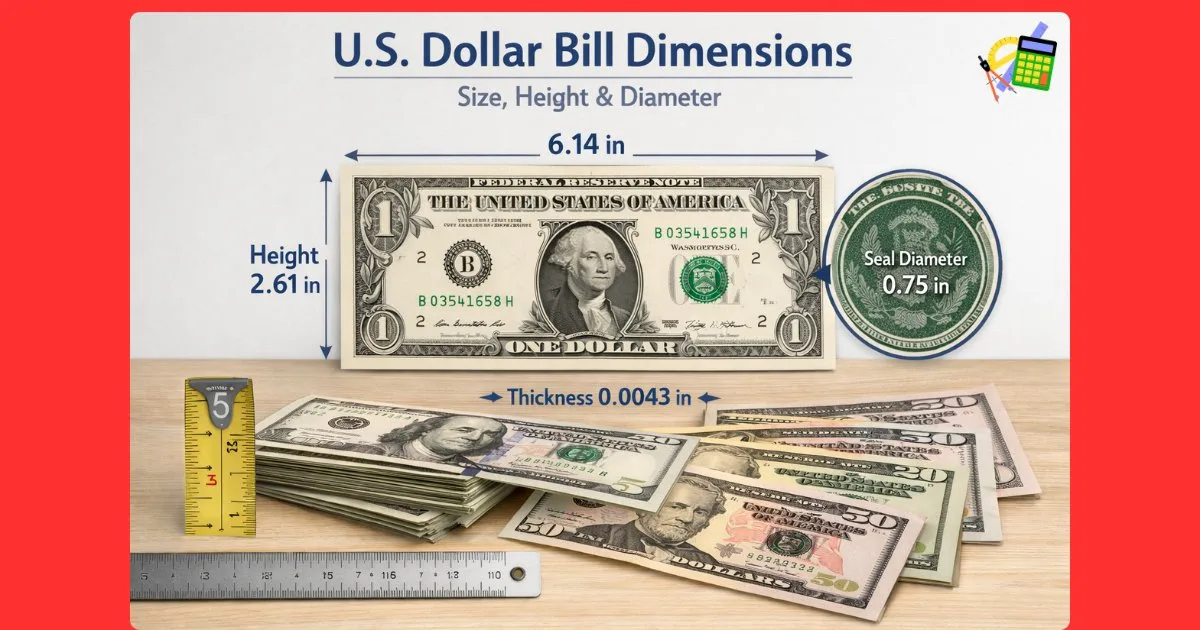
A dollar bill is 6.14 inches long and 2.61 inches wide. Thickness is 0.0043 inches per bill. These dimensions come from official U.S. Treasury specs.
They ensure bills fit pockets and machines. Weight is light too—about one gram each. This makes carrying cash easy.
Height and Width Explained
Hold a bill portrait-style. The height is 2.61 inches—the shorter side. Width is 6.14 inches across. People often mix these, but dollar bill height refers to vertical measure.
This setup fits standard wallets. Most American card slots match this width.
Addressing “Diameter” in Dollar Bill Context
Bills are rectangles, so no true diameter. This term might confuse with coins. Quarters have a 0.955-inch diameter.
For bills, think of circular seals—like the Treasury seal at 0.75 inches across.
Dimensions Across Denominations
All share the same US dollar bill dimensions. Design differs, but not size.
$1 Bill Dimensions: Size, Height & Diameter
The $1 bill measures 6.14 inches by 2.61 inches. No diameter here. It features George Washington and the Great Seal.
$5, $10, and $20 Bill Measurements
These match exactly: 6.14 inches long, 2.61 inches high. The $5 bill has Lincoln, $10 bill Hamilton, $20 bill Jackson. Colors vary for quick spotting.
Higher Denominations: $50 and $100 Bill Sizes
$50 bills with Grant and $100 bills with Franklin are identical in dimensions. Rarer in use, but same height and width.
More Posts: White Claw Can Dimensions: Size, Height & Diameter
Comparisons and Calculations
See how dollar bill sizes stack up.
Stacking and Volume: How Dimensions Add Up
1,000 bills stack to about 4.3 inches high. A million $1 bills take a pallet’s space.
Calculations use thickness for volume estimates.
Dollar Bill vs. Coins and Other Currency Forms
Coins have diameters—dimes at 0.705 inches. Bills are flat, easier to carry. Digital payments skip physical sizes.
But cash remains king for many Americans.
Metric vs. Imperial Measurements
In metrics, US dollar bills are 156 mm long and 66 mm wide. Useful for international comparisons.
Most USA folks stick to inches.
Security Features Tied to Dimensions
Fixed sizes boost safety.
How Size Enables Anti-Counterfeiting
Within 6.14 by 2.61 inches, features like plastic strips fit perfectly. UV inks and microprints use the space wisely.
The Treasury updates these without changing dimensions.
Evolution of Materials Affecting Thickness
Bills mix 75% cotton, 25% linen. This blend keeps thickness at 0.0043 inches for durability.
Modern additions like colors don’t alter core measurements.
More Posts: Water Bottle Dimensions: Size, Height & Diameter
FAQ’s
Why is the $100,000 bill illegal to own?
The $100,000 bill was a 1934 gold certificate for Federal Reserve use only. It never entered public circulation. Owning one breaks laws against holding restricted currency. Only a few exist in museums today.
What is the size of a 100 dollar bill in inches?
A $100 bill is 6.14 inches long and 2.61 inches wide. This matches all current US dollar bill dimensions.
What are the dimensions of a $20 bill?
The $20 bill measures 6.14 inches in length and 2.61 inches in height. Uniform across denominations.
What are the dimensions of $1?
A $1 bill has dimensions of 6.14 inches by 2.61 inches. Standard for all paper money.
Can you get a $1000 dollar bill from the bank?
No, banks stopped issuing $1000 bills in 1969. They remain legal tender if you find one from collectors.
Is a $2 bill worth $5000?
Most $2 bills are worth face value. Rare ones from 1890 might fetch up to $4,500 in top condition, but not typically $5,000.
Can I get a $500 bill from the bank?
Banks don’t issue $500 bills anymore, pulled in 1969. Collectors sell them at premiums.
How much is a 1934 $100,000 bill worth today?
A 1934 $100,000 bill can sell for over $2 million at auctions, based on rarity and condition.
How much space would 1 trillion dollars take up?
Using $100 bills, 1 trillion dollars equals 10 billion notes. Stacked, they reach 631 miles high. In volume, about 9,600 cubic feet—like a large warehouse.
Conclusion
In summary, dollar bill dimensions: size, height & diameter shape US money’s core. From 6.14 inches long to uniform design, these measurements ensure ease and security. Check your wallet next time.

Hi, I’m Lachlan, the admin at Feet2Inches.com. We simplify measurements with our free feet to inches calculator—fast and accurate for any project.
Explore our blogs for tips on units like meters and yards. From DIY to daily conversions, we’ve got you.
Questions? Email admin@feet2inches.com. Let’s measure right together!