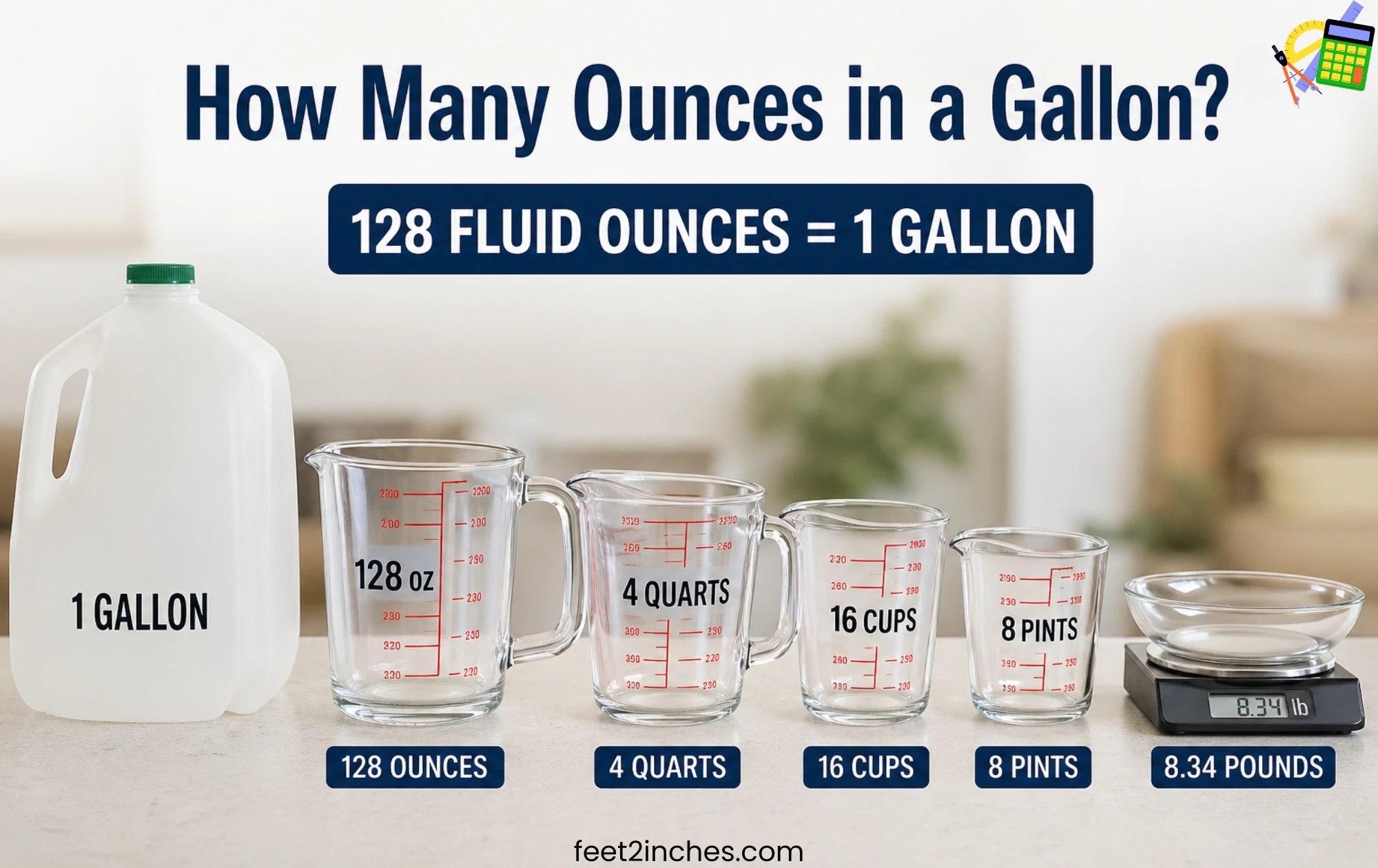
Knowing how many ounces in a gallon saves you from costly measuring mistakes in the kitchen, at the gym, and in medical care. This guide walks you through 5 real-life examples plus the most common gallon conversions, all in one place.
How Many Quarts in a Gallon
1 gallon contains exactly 4 quarts — and since each quart holds 32 fluid ounces, the math lands perfectly at 128 ounces in a gallon. Think of it this way — a standard 32 oz Gatorade bottle fills up exactly one quart.
| Gallons | Quarts |
|---|---|
| 0.5 gallon | 2 quarts |
| 1 gallon | 4 quarts |
| 2 gallons | 8 quarts |
| 5 gallons | 20 quarts |
| 10 gallons | 40 quarts |
How Many Liters in a Gallon
1 US gallon equals 3.785 liters, while 1 Imperial gallon equals 4.546 liters — a meaningful difference when you’re converting between metric and American measurements.
Since 1 liter equals roughly 33.814 fl oz, that means 3.785 liters lines up perfectly with 128 fluid ounces in a gallon.
| Gallons | Liters (US) | Liters (Imperial) |
|---|---|---|
| 1 gallon | 3.785 liters | 4.546 liters |
| 2 gallons | 7.57 liters | 9.092 liters |
| 5 gallons | 18.925 liters | 22.73 liters |
| 10 gallons | 37.85 liters | 45.46 liters |
| 25 gallons | 94.625 liters | 113.65 liters |
How Many Cups in a Gallon
1 gallon equals 16 cups — since each standard US cup holds 8 fluid ounces, multiplying 16 × 8 brings you straight to 128 oz in a gallon.
If a recipe calls for 2 cups of liquid per batch, you’d need exactly 8 batches to use up a full gallon of fluid — a practical calculation for large-scale cooking or meal prep.
| Cups | Gallons |
|---|---|
| 16 cups | 1 gallon |
| 32 cups | 2 gallons |
| 80 cups | 5 gallons |
| 128 cups | 8 gallons |
| 256 cups | 16 gallons |
How Many Pints in a Gallon
1 gallon equals 8 pints, and since each pint holds 16 fluid ounces, eight of them combine to reach the full 128 ounces in a gallon.
The pint is one of the oldest volume units in American measurement history, still widely used for milk, broth, and ice cream containers.
| Gallons | Pints |
|---|---|
| 1 gallon | 8 pints |
| 2 gallons | 16 pints |
| 3 gallons | 24 pints |
| 5 gallons | 40 pints |
| 10 gallons | 80 pints |
How Much Does a Gallon of Water Weigh
1 US gallon of water weighs 8.34 pounds at 62°F (17°C), according to the U.S. Geological Survey (USGS). In ounce terms by weight, that equals approximately 133.4 oz — slightly more than the 128 fl oz volume measurement, because weight and volume are two separate units.
| Gallons | Weight (pounds) | Weight (ounces) |
|---|---|---|
| 1 gallon | 8.34 pounds | 133.4 oz |
| 2 gallons | 16.68 pounds | 266.8 oz |
| 5 gallons | 41.7 pounds | 667 oz |
| 10 gallons | 83.4 pounds | 1334 oz |
More Posts: How Much Is a Quart? with 5 Real-Life Examples (2026)
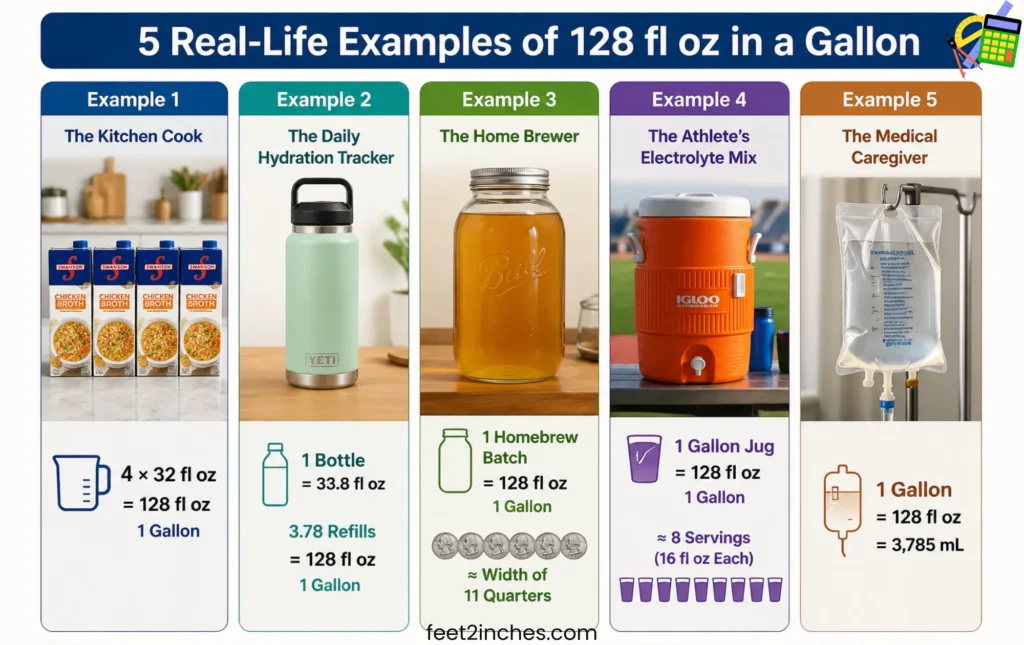
5 Real-Life Examples of How Many Ounces in a Gallon
The Kitchen Cook
A standard Swanson chicken broth carton holds 32 fl oz — exactly one quart. To fill a full gallon for a large-batch soup recipe, you’d need 4 of those cartons lined up end to end, totaling the full 128 oz in a gallon. That’s roughly the span of a forearm and a half stretched across your kitchen counter.
The Daily Hydration Tracker
A YETI Yonder 1L water bottle holds 33.8 fl oz, meaning you’d need to refill it 3.78 times to hit one full gallon. The American Academy of Family Physicians recommends 64–128 oz of daily fluid intake, so one gallon sits at the upper end of that healthy hydration range.
The Home Brewer
A standard 1-gallon homebrew batch — common with Ball Wide-Mouth Mason Jar setups — holds exactly 128 fl oz of liquid. Laid out in quarters, that’s about the width of 11 standard quarters placed side by side, giving you a tangible coin-based reference for the volume.
The Athlete’s Electrolyte Mix
Athletic trainers at U.S. high schools and colleges use 128 oz per gallon as the standard dilution benchmark when mixing powdered electrolyte drinks for full team servings. A single gallon jug — like a standard Igloo one-gallon beverage cooler — holds exactly 128 fl oz, enough for roughly 8 standard 16 oz athlete servings.
The Medical Caregiver
Hospital IV fluid bags are measured in milliliters, and 1 US gallon equals 3,785 mL. At-home caregivers who convert fluid intake logs from ounces to milliliters use the 128 oz = 1 gallon anchor to cross-check daily totals — a critical accuracy step in post-surgical hydration monitoring recommended by U.S. nursing guidelines.
More Posts: How Much Is a Pint? with 5 Real-Life Examples (2026)
Conclusion
There are 128 fluid ounces in a gallon — the single most important liquid measurement conversion in American daily life. Whether you’re cooking, hydrating, brewing, or caregiving, knowing how many ounces in a gallon keeps every measurement precise and trustworthy.
FAQ’s About How Many Quarts in a Gallon
How many ounces in a gallon of water?
There are 128 fluid ounces in a gallon of water — the official U.S. standard defined by NIST and used in kitchens, gyms, and clinical hydration tracking nationwide.
How many 32 oz bottles make a gallon?
It takes exactly 4 bottles of 32 oz to equal 1 gallon, since 4 × 32 = 128 fluid ounces in a gallon — a simple and reliable conversion.
How many 16 oz bottles make a gallon?
You need 8 bottles of 16 oz to reach a full gallon — because 8 × 16 equals the standard 128 ounces in a gallon used across all U.S. measurements.
Is a gallon 64 oz or 128 oz?
A full US gallon is 128 fl oz — 64 oz is a half gallon, which is a common daily hydration goal recommended by many U.S. health organizations.
How many ounces in an Imperial gallon?
An Imperial gallon contains 160 fluid ounces — about 32 oz more than a US gallon, so always confirm which system a recipe or product label uses.
How many ounces in a half gallon?
A half gallon equals exactly 64 fluid ounces — equivalent to filling a standard 64 oz Gatorade jug you’d find at any U.S. grocery or convenience store.

Hi, I’m Lachlan, the admin at Feet2Inches.com. We simplify measurements with our free feet to inches calculator—fast and accurate for any project.
Explore our blogs for tips on units like meters and yards. From DIY to daily conversions, we’ve got you.
Questions? Email admin@feet2inches.com. Let’s measure right together!