Most Americans hear “kilometer” on GPS devices, road signs in Canada, or during 5K race registrations, yet struggle to picture the actual distance. This guide breaks down how long a kilometer really is using clear conversions and 5 grounded real-life examples you’ll never forget.
How Far Is a Kilometer
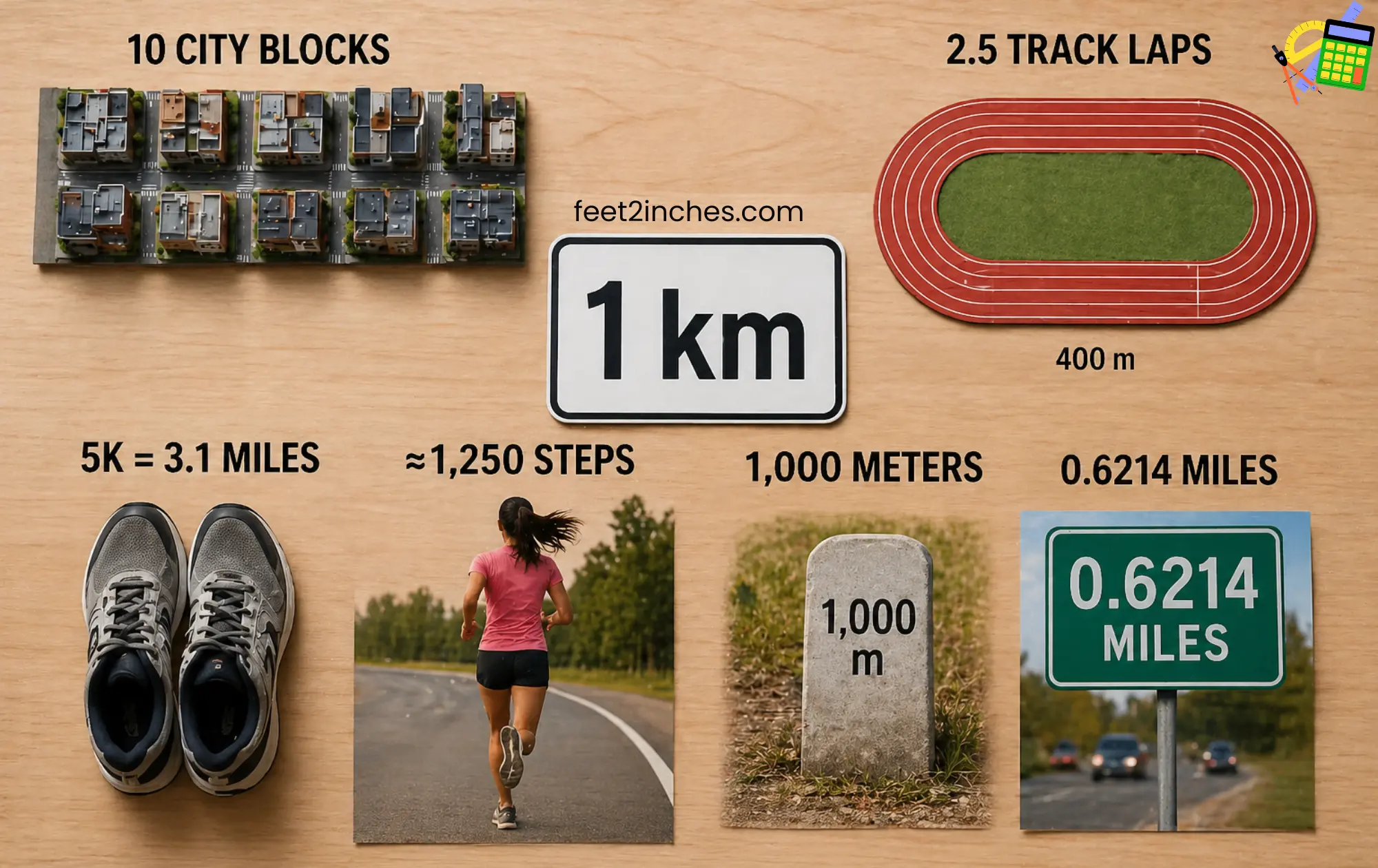
How far is a kilometer in terms you already know? It’s approximately the length of 10 standard American city blocks, a distance most people walk without giving it a second thought.
At a normal pace, the average adult covers 1 kilometer in about 10–12 minutes — making it a very manageable, everyday distance.
| Meters | Kilometers |
|---|---|
| 100 meters | 0.1 kilometer |
| 250 meters | 0.25 kilometer |
| 500 meters | 0.5 kilometer |
| 750 meters | 0.75 kilometer |
| 1000 meters | 1 kilometer |
How Much Is a Kilometer
How much distance does 1 kilometer actually represent? Think of a standard 400-meter Olympic running track, the same size used in every U.S. high school and NCAA facility — you’d need to complete exactly 2.5 laps to cover one full kilometer.
1 kilometer isn’t a long distance — it’s a precise, purposeful unit that sits comfortably between a casual stroll and a serious workout.
| Kilometers | Meters |
|---|---|
| 0.5 kilometer | 500 meters |
| 1 kilometer | 1,000 meters |
| 2 kilometers | 2,000 meters |
| 5 kilometers | 5,000 meters |
| 10 kilometers | 10,000 meters |
How Many Miles in a Kilometer
1 kilometer equals 0.6214 miles — just under two-thirds of a full imperial mile. The simplest way to remember this: a 5-kilometer race, the most popular road race distance across the United States, covers exactly 3.1 miles.
Flip that around and 1 mile equals approximately 1.609 kilometers, meaning a mile is about 60% longer than a single kilometer.
| Kilometers | Miles |
|---|---|
| 1 kilometer | 0.6214 miles |
| 2 kilometers | 1.2428 miles |
| 5 kilometers | 3.107 miles |
| 10 kilometers | 6.214 miles |
| 20 kilometers | 12.428 miles |
How Many Meters in a Kilometer
1 kilometer contains exactly 1,000 meters — no rounding, no approximation, just clean metric precision built into the system from the start.
To make 1,000 meters feel physical, consider your own body. The average adult stride measures roughly 0.75–0.80 meters, which means it takes approximately 1,250 to 1,333 steps to walk one full kilometer from start to finish.
| Kilometers | Meters |
|---|---|
| 1 kilometer | 1,000 meters |
| 2 kilometers | 2,000 meters |
| 5 kilometers | 5,000 meters |
| 10 kilometers | 10,000 meters |
| 25 kilometers | 25,000 meters |
More Posts: How Long Is a Meter? with 5 Real-Life Examples (2026)
Real-Life Examples of How Long a Kilometer Is
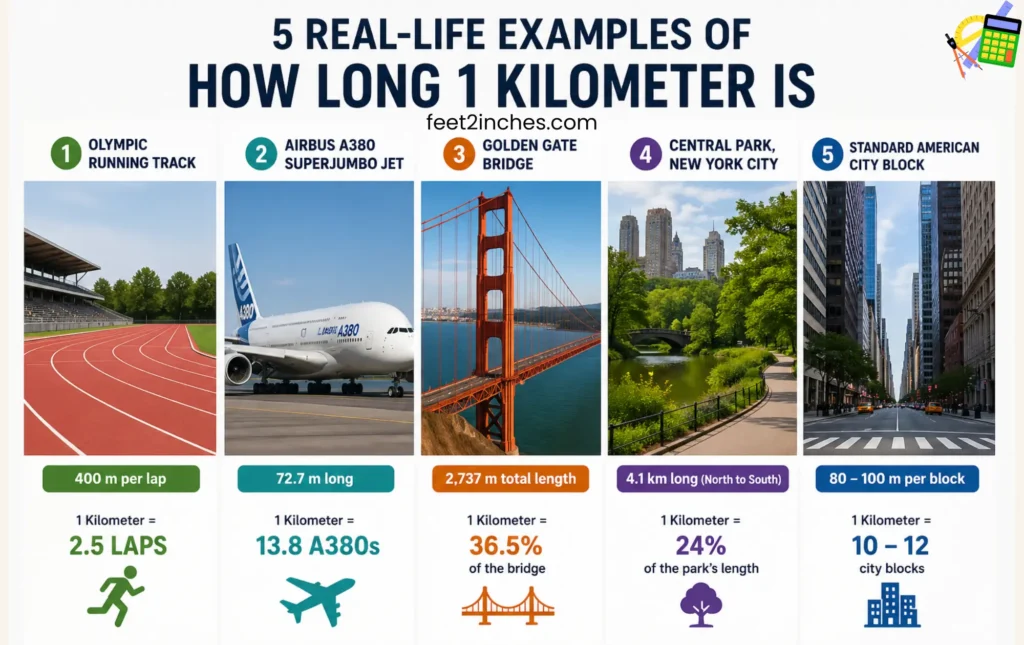
Standard Olympic Running Track — 400 Meters Per Lap
A standard outdoor Olympic running track measures exactly 400 meters per lap, as certified by World Athletics (formerly IAAF) — the same specification used in every U.S. high school and college athletic facility. To cover 1 full kilometer, you’d need to run exactly 2.5 laps around that track without stopping.
If you lined up U.S. quarters (each 24.26 mm in diameter, per the U.S. Mint) edge to edge around the track, you’d use roughly 16,490 coins per single lap — and approximately 41,227 quarters to span the full kilometer. Cardiologists frequently use the 2.5-lap benchmark as a starting endurance target for patients beginning cardiac rehabilitation programs after heart procedures.
Airbus A380 Superjumbo Jet — 72.7 Meters Long
The Airbus A380, the world’s largest commercial passenger aircraft, measures exactly 72.7 meters from nose to tail according to Airbus’s official technical specifications. To visualize 1 kilometer, you’d need to place approximately 13.8 A380s bumper to bumper in a perfectly straight line.
The average adult hand span measures about 20 cm across — meaning it would take roughly 5,000 hand spans laid flat end to end to match one full kilometer. Radiologists and medical educators frequently use large aircraft comparisons when explaining distance-based measurements to patients unfamiliar with metric units, bridging clinical data with recognizable scale.
Golden Gate Bridge — 2.737 Kilometers Total Length
The Golden Gate Bridge stretches a total of 2,737 meters (2.737 km) from end to end, according to the Golden Gate Bridge Highway and Transportation District’s official records. That means 1 kilometer represents approximately 36.5% of the bridge’s full span — just over a third of the way across.
Walking from the south tower to just past the midpoint of the Golden Gate marks almost exactly 1 kilometer of distance. Physical therapists in the San Francisco Bay Area actually prescribe bridge walks using that 1 km midpoint marker as a benchmark for post-surgery mobility recovery in orthopedic patients.
Central Park, New York City — 4.1 Kilometers Long
Central Park in Manhattan stretches 4.1 kilometers from north to south and 0.8 kilometers wide, according to the NYC Department of Parks & Recreation. One kilometer covers roughly 24% of the park’s full north-south length — from the 59th Street entrance up to approximately the 72nd Street Transverse.
The average adult foot length is about 26 cm; heel-to-toe, it takes roughly 3,846 foot-length placements to cover that single kilometer through the park. The American Heart Association specifically references urban park walking routes like Central Park’s kilometer markers as ideal settings for daily cardiovascular exercise targets in city-dwelling adults.
Standard American City Block — 80 to 100 Meters
A standard U.S. city block averages between 80 and 100 meters in length, according to U.S. Department of Transportation urban planning standards — though this varies by city grid design. It takes approximately 10 to 12 city blocks to equal one full kilometer, depending on which American city you’re walking through.
In Midtown Manhattan, 10 north-south blocks carry you from 42nd Street (Grand Central Terminal) to approximately 52nd Street — a walk that equals almost exactly 1 kilometer. Occupational therapists use this “10-city-block rule” as a post-stroke walking endurance target, since 1 km of urban walking closely mirrors the functional mobility demands of real daily life.
More Posts: How Long Is a Centimeter? with 5 Real-Life Examples (2026)
Conclusion
1 kilometer equals 1,000 meters, 0.6214 miles, and roughly 10–12 American city blocks — a distance that’s far more familiar than most people realize.
Whether you’re reading a GPS, signing up for a 5K, or crossing into Canada, these five real-life examples give you a permanent, intuitive sense of the distance. The next time someone asks how long a kilometer is, you’ll picture that Olympic track, those city blocks, and that Golden Gate Bridge crossing without hesitation.
FAQ’s About How Long Is a Kilometer
How long is a kilometer in miles?
1 kilometer equals 0.6214 miles — just under two-thirds of a full imperial mile, making it a shorter but more granular unit of distance than the mile.
How many steps is 1 kilometer?
It takes roughly 1,250 to 1,333 steps to walk 1 kilometer, based on an average adult stride length of 0.75–0.80 meters per step.
How long does it take to walk 1 kilometer?
Most adults walk 1 kilometer in 10–12 minutes at a comfortable, moderate pace on flat terrain without stopping.
Is a kilometer longer than a mile?
No — a kilometer is shorter than a mile. One mile equals approximately 1.609 kilometers, making a mile about 60% longer than a single kilometer.
How many meters make up 1 kilometer?
Exactly 1,000 meters make up 1 kilometer — the prefix kilo- always means one thousand within the metric system.
How long is a kilometer compared to a football field?
A standard NFL football field measures 91.44 meters (100 yards) long, meaning it takes roughly 10.9 football fields placed end to end to equal 1 full kilometer.

Hi, I’m Lachlan, the admin at Feet2Inches.com. We simplify measurements with our free feet to inches calculator—fast and accurate for any project.
Explore our blogs for tips on units like meters and yards. From DIY to daily conversions, we’ve got you.
Questions? Email admin@feet2inches.com. Let’s measure right together!