A centimeter is one of the most widely used units in the metric system, yet most people in the USA find it hard to picture exactly how long is a centimeter without a ruler in hand.
How Many Millimeters in a Centimeter
1 centimeter equals exactly 10 millimeters — this is one of the most fundamental relationships in the metric system.
Think of it this way: if a single grain of rice is roughly 1 mm wide, then ten grains lined up side by side would equal one full centimeter.
| Centimeters | Millimeters |
|---|---|
| 1 centimeter | 10 millimeters |
| 2 centimeters | 20 millimeters |
| 5 centimeters | 50 millimeters |
| 10 centimeters | 100 millimeters |
| 25 centimeters | 250 millimeters |
How Many Inches in a Centimeter
1 centimeter equals approximately 0.39 inches, or flipped around, 1 inch equals 2.54 centimeters exactly. For USA readers who switch between metric and imperial systems daily, this conversion is something worth memorizing.
| Inches | Centimeters |
|---|---|
| 1 inch | 2.54 centimeters |
| 2 inches | 5.08 centimeters |
| 5 inches | 12.7 centimeters |
| 10 inches | 25.4 centimeters |
| 12 inches | 30.48 centimeters |
How Much Is a Centimeter
One centimeter is exactly one-hundredth of a meter — a small but mighty unit used across science, medicine, and everyday life. Doctors measure wound sizes, tumor dimensions, and newborn head circumference all in centimeters because the metric system allows for precise, universally understood reporting.
| Centimeters | Meters |
|---|---|
| 1 centimeter | 0.01 meters |
| 2 centimeters | 0.02 meters |
| 5 centimeters | 0.05 meters |
| 10 centimeters | 0.1 meters |
| 100 centimeters | 1 meter |
How Big Is a Centimeter
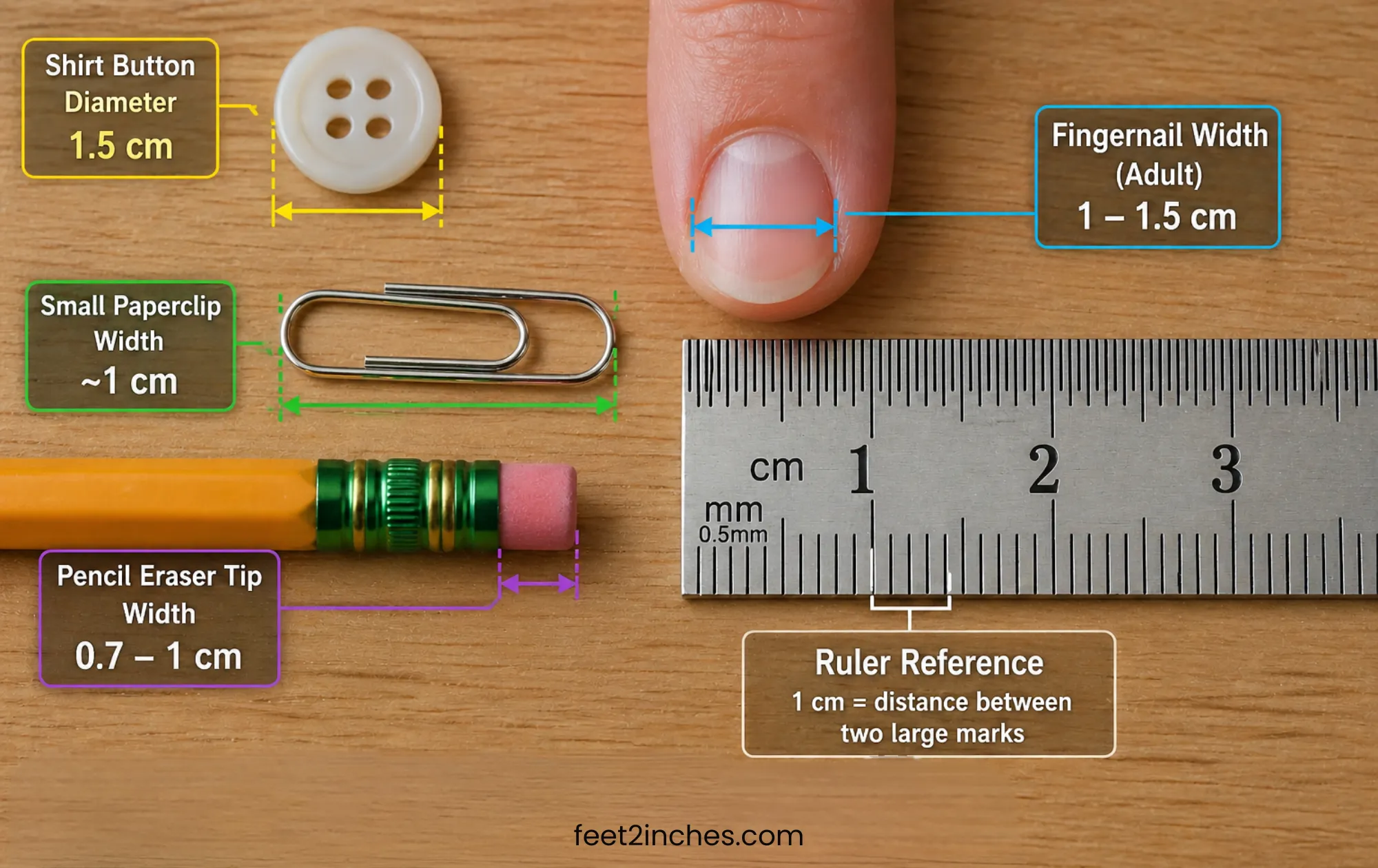
Visually, 1 centimeter is about the width of your pinky fingernail — a fact that nurses and measurement pros use as a quick bedside reference. It is noticeably smaller than an inch but large enough to be seen and measured with the naked eye without any difficulty.
| Object | Approx. Size (cm) |
|---|---|
| 1 centimeter reference | Width of a pinky fingernail (~1 cm) |
| Standard shirt button | 1 – 2 centimeters |
| Small paperclip width | ~1 centimeter |
| Fingernail width (adult) | ~1 – 1.5 centimeters |
| Erasing tip of pencil | ~0.7 – 1 centimeter |
More Posts: 55 Inches in Length With 8 Everyday Examples (2026)
5 Real-Life Examples
A Standard Staple Is About 1 Centimeter Wide
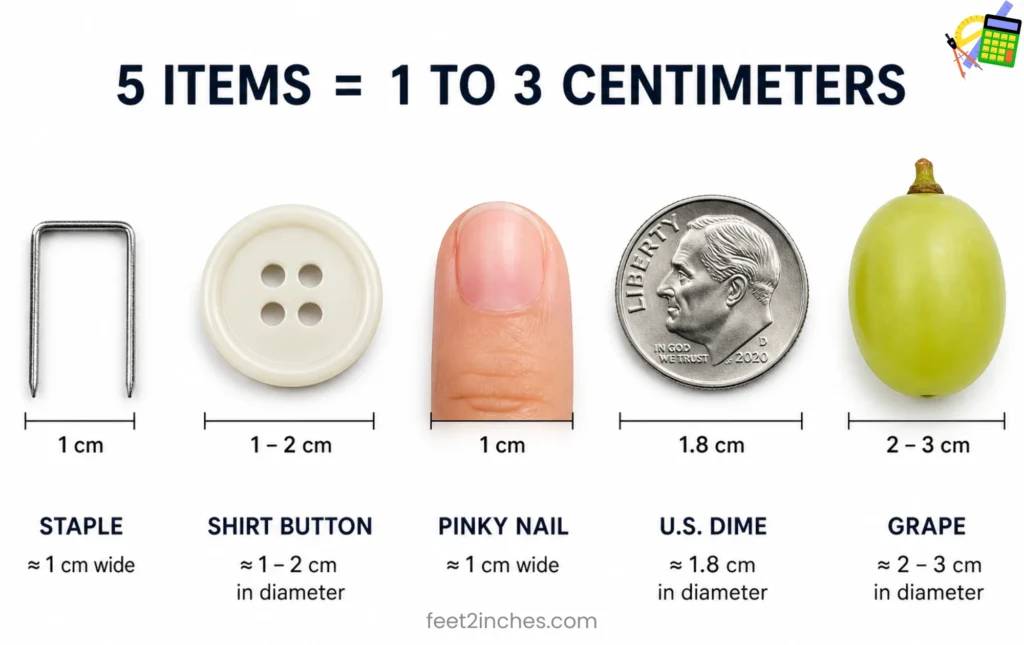
A regular office staple — the kind loaded into any Swingline or Bostitch stapler — measures almost exactly 1 cm across when closed. It is one of the most precise and consistent everyday objects you can use to visualize a centimeter.
Most Americans have staples sitting on their desk or in a drawer right now, which makes this reference instantly accessible. Next time you need a quick mental image of how long is a centimeter, just picture the flat width of a single closed staple.
The Diameter of a Shirt Button Is 1 to 2 Centimeters
A standard dress shirt button typically has a diameter ranging from 1 cm to 2 cm, depending on its position on the garment. Collar buttons tend to sit at the smaller end, while mid-shirt buttons are closer to the 1.5 cm mark.
Tailors, seamstresses, and clothing manufacturers use centimeter measurements as their default standard. This makes the shirt button one of the most tactile and relatable centimeter examples for anyone interested in fashion, crafting, or alterations.
A Pinky Fingernail Is Approximately 1 Centimeter Wide
The average adult pinky fingernail measures right around 1 cm in width — a fact widely referenced in nursing education and first-aid training. It turns your own hand into a zero-cost, always-available measuring tool.
This technique, sometimes called the “body ruler” method, is taught in healthcare settings where quick visual estimates of wound size or skin lesion diameter are needed. Knowing your pinky nail equals roughly 1 centimeter is one of the most practical measurement skills you can carry anywhere.
A U.S. Dime Is About 1.8 Centimeters in Diameter
The United States dime, issued by the U.S. Mint, has an official diameter of 17.91 mm — just under 1.8 centimeters. Because its size is regulated by federal standards, it is one of the most dimensionally consistent everyday objects in America.
Pulling a dime out of your pocket gives you an instant reference slightly below 2 cm. For anyone learning how long is a centimeter in practical terms, the dime is arguably the most reliable coin-based measuring reference available in the USA.
A Grape Is Roughly 2 to 3 Centimeters in Diameter
A standard table grape — whether a Thompson Seedless, Red Globe, or Concord variety — typically measures between 2 cm and 3 cm in diameter at its widest point. Size varies slightly by variety and growing conditions, but this range holds consistently.
Doctors and oncologists often describe masses, lymph nodes, and cysts as being “the size of a grape,” which directly maps to that 2–3 cm measurement range. Understanding this helps patients and caregivers immediately grasp the physical scale being described in a medical context.
More Posts: 42 Inches in Length With 8 Everyday Examples (2026)
Conclusion
Now that you have five concrete, everyday references, understanding how long is a centimeter should feel completely natural rather than abstract or confusing. From a dime in your pocket to a grape on your plate, accurate centimeter visualization is always within reach. Keep these references in mind and you will never need to guess at a centimeter measurement again.
FAQ’s About How Long Is a Centimeter
How long is a centimeter exactly?
One centimeter equals exactly 10 millimeters, 0.01 meters, or approximately 0.39 inches — making it a small, precise metric unit used globally across science, medicine, and everyday measurement.
How many centimeters are in an inch?
There are exactly 2.54 centimeters in one inch. To convert inches to centimeters, simply multiply your inch value by 2.54 for a precise metric result.
What common object is exactly 1 centimeter?
The width of a standard office staple and the width of an average adult pinky fingernail are both approximately 1 centimeter, making them the most reliable everyday references.
Is a centimeter bigger than a millimeter?
Yes — one centimeter is exactly 10 times larger than one millimeter. In the metric system, millimeters are the smaller unit while centimeters represent the next step up in length measurement.
Why do doctors use centimeters to measure?
Doctors use centimeters because the metric system offers universally consistent precision, making it easier to document and communicate measurements of wounds, tumors, and fetal development across medical teams worldwide.
How do you measure centimeters without a ruler?
Use everyday objects as references — a pinky fingernail (~1 cm), a U.S. dime (~1.8 cm), or a shirt button (~1–2 cm) all provide quick, reliable centimeter estimates without any measuring tool.

Hi, I’m Lachlan, the admin at Feet2Inches.com. We simplify measurements with our free feet to inches calculator—fast and accurate for any project.
Explore our blogs for tips on units like meters and yards. From DIY to daily conversions, we’ve got you.
Questions? Email admin@feet2inches.com. Let’s measure right together!